AI Keyword Classifier
Rules-first AI classification - 50 hours/month saved, <$1 per run
- Client
- Copenhagen-based SEO agency
- Industry
- Digital Marketing
- Period
- September 2025 - Present
- Role
- Independent Consultant
The Problem
Every SEO strategy requires keyword classification - categorizing thousands of keywords by intent, topic, funnel stage, and other dimensions. At this 60-client agency:
Manual classification was consuming massive analyst time:
- Each new client required hours of keyword tagging
- 60 clients meant endless categorization work
- Inconsistency across team members created reporting problems
- High-value analysts spent time on low-value data entry
The real cost: Approximately 50 hours per month per SEO analyst spent on manual keyword classification instead of strategy work.
The Solution
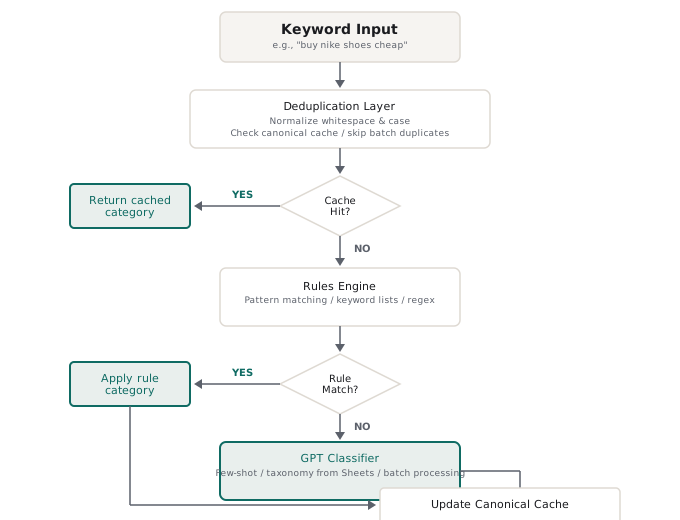
Architecture: Rules First, AI Second
Why Rules First?
| Approach | Cost per 10K keywords | Consistency | Speed |
|---|---|---|---|
| 100% GPT | ~$5-10 | Variable | Slow |
| Rules only | $0 | High | Fast |
| Rules + GPT fallback | <$1 | High | Fast |
Most keywords fall into predictable patterns. Rules handle 70-80% of classifications; GPT handles the edge cases.
The Hybrid Approach
-
Rules handle the obvious (70-80% of keywords)
- “buy nike shoes” → Transactional (rule: “buy *”)
- “how to do seo” → Informational (rule: “how to *”)
-
AI handles the ambiguous (20-30% of keywords)
- Only keywords that don’t match rules go to GPT-4
- Dramatically reduces AI costs
-
Learning compounds
- Once a keyword is classified, it’s cached
- New clients benefit from prior classifications
Google Sheets Integration
Why Sheets?
- SEO team can edit rules without code deployments
- Taxonomy visible and auditable
- Version history built-in
- Collaborative editing
Sheet 1: Taxonomy
| Category | Description | Parent |
|---|---|---|
| Transactional | Purchase intent keywords | Intent |
| Informational | Research/learning keywords | Intent |
| Navigational | Brand/site search keywords | Intent |
Sheet 2: Rules
| Pattern | Category | Priority |
|---|---|---|
| buy * | Transactional | 1 |
| how to * | Informational | 1 |
| * price | Transactional | 2 |
Results
Cost Economics
Before: Manual Classification
| Metric | Value |
|---|---|
| Analyst hourly cost | ~$50/hour |
| Hours per 10,000 keywords | ~5 hours |
| Cost per classification run | ~$250 |
After: Automated Classification
| Metric | Value |
|---|---|
| OpenAI API cost | <$1 per run |
| Analyst review time | ~15 minutes |
| Total cost per run | <$15 |
ROI: 94% cost reduction per classification task
Production Metrics
| Metric | Value |
|---|---|
| Time savings | ~50 hours/month per employee |
| Cost per run | <$1 OpenAI API |
| Test scale | 10,000 rows × 3 columns |
| Users | Entire SEO team |
Operational Benefits
| Before | After |
|---|---|
| 4-6 hours to classify new client keywords | 15 minutes to run and review |
| Different analysts categorized differently | Single source of truth |
| More clients = more analyst hours | More clients = same infrastructure |
| Classification rules locked in code | SEO team updates rules via Sheets |
Technology Stack
| Component | Technology |
|---|---|
| Compute | Google Cloud Run |
| LLM | OpenAI GPT-4 |
| Configuration | Google Sheets API |
| Language | Python |
Why Not Just Use ChatGPT?
Common question: “Can’t we just paste keywords into ChatGPT?”
| Manual ChatGPT | This System |
|---|---|
| Copy-paste required | Fully automated |
| Inconsistent formatting | Standardized output |
| No memory across runs | Persistent cache |
| $5-10 per large batch | <$1 per batch |
| No audit trail | Full logging |
| One person at a time | Team-wide access |
Lessons Learned
-
Rules beat AI for predictable patterns. 70-80% of keywords follow patterns that simple rules handle faster and cheaper than LLMs. This exemplifies a core principle: workflows with model-powered steps outperform pure agent approaches when the path is predictable and cost-sensitive.
-
Deduplication is a multiplier. Aggressive dedup before API calls dramatically reduces costs and improves consistency.
-
Google Sheets as config layer works. Non-technical team members can update rules without developer involvement.
-
Batch processing is essential. Per-keyword API calls are too expensive at scale.
-
Start with cost constraints. Designing for <$1/run forced good architecture decisions (dedup, caching, rules-first).
Impact
This system changed how the SEO team operates:
- Analysts focus on strategy, not data entry. 50 hours per month per employee shifted from classification to client work.
- New client onboarding dropped from days to minutes. What took a week-long classification sprint now runs while you grab coffee.
- The classification cache compounds. Every new client benefits from prior classifications - a growing advantage over competitors starting fresh each time.
The ROI paid for the development in the first month.
Want to discuss AI classification?
Building a similar system for keyword tagging, content categorization, or document classification? I design cost-controlled AI systems that handle the predictable with rules and the ambiguous with LLMs - all without breaking the budget. Get in touch.