What Are Workflows and Agents
The distinction that matters is simpler than the terminology suggests. In a workflow, you define what happens. In an agent, the model defines what happens. Understanding when to use each - and how to combine them - is most of what separates successful AI implementations from expensive experiments.
TL;DR: In a workflow, you define what happens. In an agent, the model decides. Most production systems need both - deterministic orchestration with model-driven components at specific points. The mistake companies make is reaching for agents when workflows would do, a pattern I call “premature autonomy.” Match the approach to the problem structure: workflows for predictable paths, agents only where the path genuinely can’t be specified in advance and failures get caught before they matter.
The Only Distinction That Matters
The language around AI automation has gotten sloppy. “Agent” shows up in marketing materials for everything from chatbots to autonomous systems. “Workflow” sounds like something from 2018’s robotic process automation hype cycle. Neither term, as commonly used, helps anyone decide what to actually build.
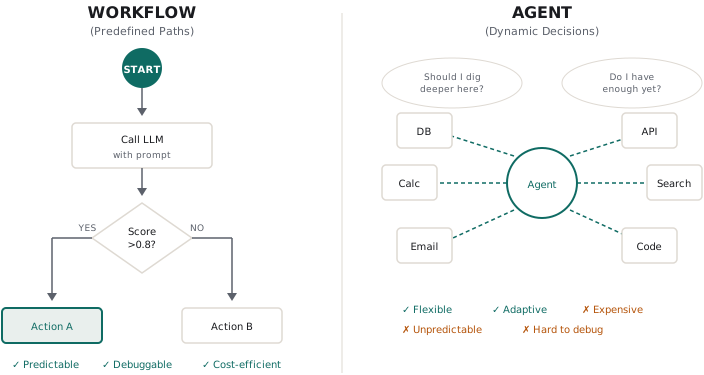
The distinction that matters is simpler. In a workflow, you define what happens. In an agent, the model defines what happens. Same underlying technology - LLMs, tool integrations, data pipelines. Different architecture: who decides the next step.
A workflow receives an input and follows a predetermined path. Document arrives, classify it. Invoice? Extract these fields. Confidence below threshold? Flag for review. The logic is explicit, written in code, auditable by anyone who can read it. The model provides capabilities - classification, extraction, summarization - but the orchestration is yours.
An agent receives a goal and figures out the path. “Review this document for compliance issues.” The model decides what to look for, which tools to use, when to dig deeper, when to stop. The logic emerges from the model’s reasoning rather than your specification. You define the objective and constraints; the model handles execution.
This isn’t a spectrum. Most production systems combine both - deterministic orchestration with model-driven components at specific points. The question isn’t which approach to use, but where each belongs.
Workflows: Predictable and Debuggable
The case for workflows is predictability. When the path through a problem is knowable in advance, encoding it explicitly produces systems that are easier to debug, maintain, and explain. A workflow that breaks does so in traceable ways. You can identify which step failed, examine inputs and outputs, fix the logic. Failure modes are bounded by the logic you wrote.
Consider document processing at scale. Thousands of invoices daily, each needing classification, extraction, validation, routing. Input variance is high - different vendors, formats, edge cases - but the process itself is stable. Classify, extract, validate, route. A workflow handles this because the steps don’t change even when inputs do. Model-powered components handle variance (recognizing an invoice regardless of format), deterministic logic handles flow (what to do once it’s recognized).
The limitation is brittleness at the edges. Every workflow encodes assumptions about the world. When reality violates those assumptions - a document type that wasn’t anticipated, a combination of conditions the logic doesn’t handle - the workflow either fails explicitly or produces wrong outputs silently. Maintaining workflows means continuously updating them as edge cases emerge. That works until edge cases outnumber common cases.
Agents: Flexible and Unpredictable
The case for agents is flexibility. When the path through a problem depends on what you find along the way, specifying it in advance isn’t possible. Research tasks have this quality - you don’t know which sources will be relevant until you start looking. Complex troubleshooting too - diagnosis depends on symptoms that reveal themselves progressively. These problems require exploration, and exploration is what agents do.
An agent given a research goal will search, read, evaluate relevance, search again based on what it learned, synthesize across sources, iterate until it has enough. No predetermined sequence could replicate this because the steps depend on intermediate results. The value of the agent is precisely that it can navigate uncertainty.
The limitation is unpredictability. Same input may produce different behavior on different runs. An agent might interpret a goal differently than intended, use tools in unexpected ways, get stuck in loops, or take actions that seem reasonable from its perspective but aren’t what you wanted. Debugging means reconstructing what the model was “thinking” - which ranges from difficult to impossible depending on instrumentation.
This unpredictability compounds with autonomy. A workflow that processes a document incorrectly produces one bad output. An agent that misinterprets a goal and operates for an extended period can produce cascading errors before anyone notices. More autonomy, larger blast radius.
The Problem: Premature Autonomy
Most companies considering AI automation face problems that look more like document processing than open-ended research. High-volume, repetitive work with variance in inputs but stability in process. The instinct, fed by vendor marketing and industry hype, is to reach for agents. The result is often what I call premature autonomy - building sophisticated systems for problems that needed simple ones.
The pattern recurs. Company identifies expensive manual work. They evaluate AI solutions. Vendors demonstrate impressive agent capabilities - ask it anything, watch it figure it out. The demo works because demos are designed to work. In production, the agent encounters edge cases the demo didn’t include, makes confident errors requiring human correction, and eventually gets relegated to a narrow subset of its intended scope. Or abandoned entirely.
The alternative starts with decomposition. What are the actual steps in this process? Which steps require judgment - genuine reasoning about ambiguous situations - and which are just labor? Labor steps are workflow candidates. Automate them with deterministic logic, using models for capabilities like classification or extraction but keeping orchestration explicit. Judgment steps might need agent-like flexibility, or they might need humans with better tooling.
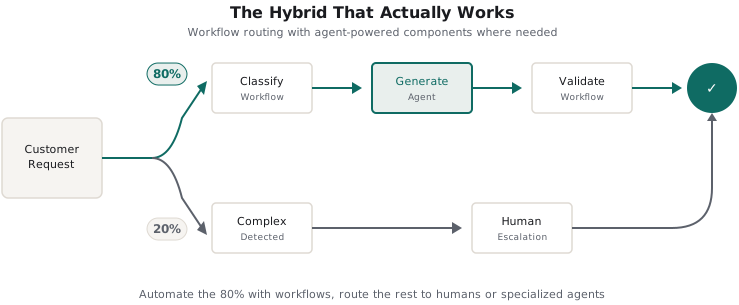
This decomposition often reveals that judgment steps are smaller than assumed. Support operations that seem to require constant human reasoning often consist of 80% routine cases, 15% that need information lookup but follow standard patterns, and 5% that genuinely require judgment. Automating the 80% with workflows while routing the rest appropriately beats an agent trying to handle everything.
When Agents Actually Make Sense
Agents genuinely belong in problems with two characteristics: the path can’t be specified in advance, and failures can be caught before they matter.
The first is about problem structure. If you can draw the decision tree on a whiteboard, you don’t need an agent - you need a workflow that implements that tree. If the tree would be infinite because each branch depends on what you find, an agent makes sense.
The second is about risk tolerance. Agents make mistakes. If those mistakes get caught through automated verification - tests that pass or fail, outputs validated against criteria - the system can iterate toward correctness. If mistakes propagate before detection, cost scales with time to detection. Low-stakes domains with fast feedback loops can tolerate agent autonomy. High-stakes domains with slow feedback loops usually can’t.
Software development fits both criteria for certain tasks. An agent that writes code, runs tests, sees failures, and revises can be useful because tests bound the errors. The agent’s autonomy operates within automated verification. Research and synthesis tasks can also fit if human review happens before outputs matter - agent explores, surfaces findings, human evaluates before decisions are made.
Regulatory and compliance contexts rarely fit. Error cost is high, feedback loops are slow, auditability requirements demand explicit logic. This doesn’t mean AI has no role - models can power components within workflows, providing capabilities like document understanding or anomaly detection - but orchestration needs to be deterministic and traceable.
The Hybrid That Actually Works
The most effective production systems treat workflows and agents as complementary, not competing. Workflow provides structure: defined entry points, explicit routing, predictable state transitions, clear audit trails. Agent-like components provide flexibility at specific points: generating content, analyzing unstructured inputs, making recommendations based on context. The combination offers both reliability and capability.
A customer support system might route incoming requests through a classifier (workflow), generate draft responses using context from knowledge base and conversation history (agent-like component), validate responses against compliance rules (workflow), and escalate to humans when confidence is low (workflow). Overall system is deterministic and auditable. Response generation benefits from model flexibility. Neither approach could achieve what the combination does.
This architecture - workflows with agent-powered steps - handles most automation needs better than pure approaches. It acknowledges that some tasks benefit from model reasoning while maintaining the predictability and observability that production systems require. I applied this exact pattern when building a multi-agent FDA document review system that achieved 60-70% time savings on regulatory submissions - deterministic orchestration with model-powered analysis at specific steps.
Making It Work in Practice
Implementing this well requires attention to interfaces between deterministic and model-driven components. The workflow needs to provide context the model component needs and interpret outputs in ways downstream logic expects. Poor interfaces produce failures that are hard to diagnose - model component works in isolation but breaks in context, or workflow handles model outputs incorrectly.
It also requires observability throughout. Every step, workflow or agent, should produce logs sufficient to reconstruct what happened. For workflows, this is straightforward - log inputs, decisions, outputs. For agent-like components, this means logging reasoning, tool calls, intermediate states. When something breaks, you need the information to understand why.
The goal isn’t to eliminate agent-like behavior but to bound it. Give models room to reason where reasoning adds value. Constrain them with explicit logic everywhere else. Trust capabilities while building systems that remain understandable and maintainable by humans.
The Boring Systems That Win
Companies that succeed with AI automation share a mindset. They’re skeptical of sophistication for its own sake. They decompose problems before solving them. They match approaches to problem structures rather than applying the same approach everywhere. They measure what matters - not model capability in isolation, but system performance in production - and iterate based on evidence.
This mindset leads to boring-looking systems. Document classifiers with confidence thresholds. Routing logic with specialized handlers. Workflows with model-powered steps for specific capabilities. Nothing that makes for impressive demos. Just systems that work, reliably, at scale.
The current moment in AI is characterized by a gap between capability and reliability. Models can do remarkable things in controlled conditions. Making those capabilities reliable in production - consistent, predictable, maintainable - requires engineering discipline that has nothing to do with the models themselves. Workflows provide that discipline. Agents trade it for flexibility.
Understanding when to make that trade, and how to make it in bounded ways, is most of what separates successful AI implementations from expensive experiments.
This is what I build. Boring systems that work - workflows with model-powered steps, explicit routing, clear audit trails. If you’re trying to figure out where workflows end and agents begin for your business, let’s talk.
Related work
AI Brain Fry Is Real - But It's Not the Tools' Fault
Harvard Business Review says AI is frying workers' brains. My data - 1,986 commits and 1,900 AI sessions in 76 days - shows the opposite is possible. The difference isn't the tools. It's whether anyone invested in actually understanding them.
Your AI Strategy Is Collecting Dust
Most AI strategies fail before implementation starts. Not because the ideas are wrong - because the strategy was built for a board deck, not for the people doing the work. Here's how to build one that actually gets executed.
Your agents know exactly what you tell them
Most people's AI instructions are empty or stale. The ones getting consistently better results are transferring judgment, not just preferences - and they have a system for keeping it current.