Product-Led Growth Engine
0 → 1,000+ users, 100% retention, 8-system commercial stack built from scratch
- Client
- Norwegian clinical research startup
- Industry
- Healthcare SaaS
- Period
- April 2020 - February 2023
- Role
- Head of Customer Experience (Employee #5)
The Challenge
State When We Started (April 2020)
| Dimension | State |
|---|---|
| Employee number | #5 |
| Users | 0 |
| Revenue | Pre-revenue |
| Commercial infrastructure | None |
| Go-to-market strategy | Undefined |
Without commercial infrastructure, the company couldn’t acquire customers, couldn’t bill them, couldn’t support them, and couldn’t track whether the product was actually working. The platform existed, but there was no way to turn it into a business.
The Mandate
Build everything needed to take the product to market:
- Growth strategy
- Commercial technology
- Customer acquisition and retention
- Support operations
- Enterprise readiness
The Solution
Why Product-Led Growth?
For a clinical research platform with limited sales resources:
| Traditional Sales | Product-Led Growth |
|---|---|
| High CAC per customer | Users try before buying |
| Sales-dependent scaling | Self-serve scales infinitely |
| Long sales cycles | Immediate value demonstration |
| Limited reach | Viral expansion within teams |
PLG Mechanics Implemented
1. Freemium Model
- Free tier with limited features
- Clear upgrade triggers
- No credit card required to start
2. Viral Invitation System
- Every user can invite teammates
- Team workspace = natural expansion
- Invited users see sender’s success
3. Self-Serve Conversion
- Upgrade in-app with credit card
- No sales call required for Pro tier
- Enterprise triggers sales involvement
4. Usage-Based Triggers
- Approaching limits → upgrade prompt
- Enterprise features → sales qualification
- High engagement → success outreach
The 8-System Commercial Stack
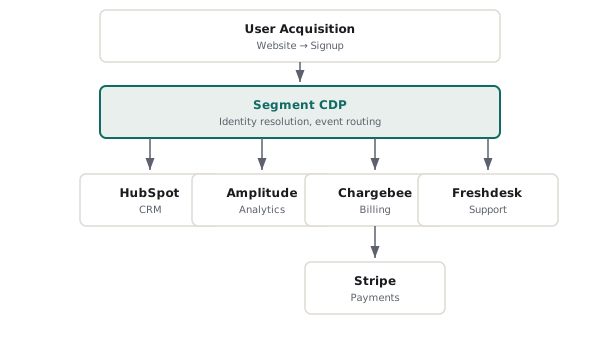
Architecture
System Breakdown
| System | Purpose | Why This Tool |
|---|---|---|
| Segment CDP | Identity resolution, event routing | Single integration point, add tools without code |
| HubSpot CRM | Customer lifecycle, sales pipeline | Lead scoring from product usage |
| Chargebee | Subscription management, invoicing | Self-serve + enterprise billing |
| Stripe | Payment processing | Industry standard, Chargebee integration |
| Amplitude | Product analytics | Retention cohorts, feature adoption |
| Fathom Analytics | Privacy-friendly web analytics | GDPR-compliant, no cookies |
| Google Analytics | Marketing attribution | SEO, campaign tracking |
| Freshdesk | Support ticketing | Tiered SLAs by plan |
Why 8 Systems?
Each system is best-in-class for its function. The alternative - one platform doing everything adequately - meant compromises everywhere.
Segment as the hub: All systems connected through Segment CDP, eliminating point-to-point integrations. Adding new tools later requires no code changes.
Implementation
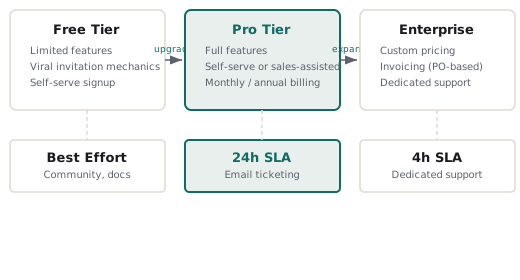
Pricing Architecture
Support Tiering
| Tier | SLA | Support Channel |
|---|---|---|
| Free | Best effort | Community, docs |
| Pro | 24h response | Email ticketing |
| Enterprise | 4h response | Dedicated support |
Team Built
| Role | Count | Focus |
|---|---|---|
| Direct report | 1 | P&L responsibility |
| Research Consultants | 3 | Customer success, domain expertise |
| Frontend developers | 2 | 2nd level support |
| Backend developers | 2 | 3rd level support |
| Total influence | ~8 |
Participated in hiring team members across support and customer success functions.
Enterprise Readiness
ISO 27001 Certification
Challenge: Enterprise customers (pharma, academic institutions) require security certifications.
Key contributions:
- Documentation of customer data flows
- Security policies for commercial systems
- Vendor security assessments
- Compliance evidence gathering
Outcome: Company achieved ISO 27001 certification - removed enterprise sales objections.
Enterprise Agreement Structure
Built templates and processes for:
- Data Processing Agreements (DPAs)
- Security questionnaire responses
- Custom contract terms
- SOC 2 readiness documentation
Results
Growth Metrics
| Metric | Value | Context |
|---|---|---|
| Users | 0 → 1,000+ | As employee #5 |
| Customers | 20-30 enterprise | B2B research institutions |
| Retention | 100% | No customers lost |
| Churn | Negative | Expansion revenue only |
What “100% Retention” Means
In a young company:
- First year had no paying customers (building product)
- Once customers started paying, none churned
- Revenue grew through expansion (more users, upgrades)
- Product stickiness demonstrated
Operational Outcomes
| System | Impact |
|---|---|
| Segment | Single integration point, hours saved per new tool |
| HubSpot | Automated 80% of lead qualification |
| Chargebee/Stripe | Self-serve billing, zero payment ops headcount |
| Amplitude | Data-driven product decisions |
| Freshdesk | Scaled support without proportional headcount |
Key Technical Decisions
| Decision | Rationale | Trade-off |
|---|---|---|
| Segment as hub | Future-proof integrations | Monthly cost |
| Chargebee over Stripe Billing | Subscription management features | Added vendor |
| Amplitude over Mixpanel | Better retention analysis | Learning curve |
| Fathom alongside GA | Privacy compliance | Dual systems |
| Freshdesk over Intercom | Cost at scale | Less in-app chat |
Lessons Learned
-
Segment is worth it early. The cost pays off when you add your 3rd analytics tool without touching code.
-
Self-serve billing is table stakes. Any friction in payment = lost conversions.
-
PLG needs metrics infrastructure. Can’t optimize what you don’t measure. Amplitude was essential.
-
Enterprise and PLG coexist. Free tier generated leads that converted to enterprise deals.
-
Support tiers let you scale. Different SLAs for different tiers prevented support team explosion.
-
ISO 27001 is a sales accelerator. Enterprise customers require it - having it removed objections.
Impact
The commercial infrastructure built during this period became the company’s growth engine:
- 100% retention meant compounding revenue - every customer acquired stayed and expanded
- Self-serve billing removed sales friction for smaller deals while enterprise processes handled larger ones
- ISO 27001 opened doors to pharma and academic institutions that wouldn’t consider uncertified vendors
- Segment-based architecture meant adding new tools (analytics, support, CRM) took hours instead of weeks
The 0-to-1 pattern - building commercial infrastructure from nothing to functioning growth engine - established the foundation for continued growth after my departure.
Glossary
| Term | Meaning |
|---|---|
| PLG | Product-Led Growth — users try the product before talking to sales |
| SaaS | Software as a Service — subscription software delivered over the internet |
| CDP | Customer Data Platform — a central hub that collects user data from all tools |
| CAC | Customer Acquisition Cost — what you spend to get one new customer |
| CRM | Customer Relationship Management — system for tracking sales leads and deals |
| SLA | Service Level Agreement — guaranteed response times for customer support |
| P&L | Profit and Loss — a financial statement showing revenue minus expenses |
| SOC 2 | A security certification that enterprise buyers require before purchasing |
| DPA | Data Processing Agreement — a legal contract governing how customer data is handled |
Want to discuss PLG infrastructure?
Building commercial infrastructure from scratch? I help early-stage companies design growth engines that scale - from self-serve billing to enterprise readiness. Get in touch.