AI Translation Pipeline for Pharma
AI translation integrated with Veeva Vault - 2+ week turnaround reduced to hours
- Client
- Two pharmaceutical clients
- Industry
- Pharmaceutical
- Period
- 2025
- Role
- Project Manager, Business-Tech Liaison
The Problem
Pharmaceutical companies translate thousands of documents annually: SOPs (Standard Operating Procedures), quality procedures, promotional materials, regulatory submissions. The standard process involves external translation agencies with 2+ week turnaround times.
| Pain Point | Business Impact |
|---|---|
| 2+ week turnaround | Delays market launches, slows compliance updates |
| Agency queue dependency | Capacity constraints during peak periods |
| Manual handoff | Staff time on export/import/tracking |
| Cost per document | Translation fees compound across markets |
For companies launching products across multiple markets, every week of translation delay means delayed market access. The question wasn’t whether AI translation was good enough - it was whether it could integrate into existing regulated workflows.
The Solution
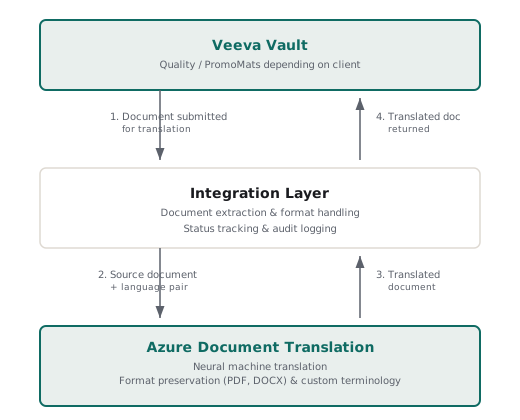
Architecture
Key Technical Decisions
| Decision | Rationale |
|---|---|
| Azure Document Translation | Format preservation (maintains tables, layouts), custom model support for domain terminology, batch processing capability |
| Veeva-native integration | Documents stay in the regulated content management system; no manual export/import; audit trail preserved |
| Human-in-the-loop | AI generates draft; domain experts validate. Required for regulated content, but validation is faster than creation |
Pharma-Specific Requirements
Veeva Vault is the content management platform most large pharma companies use for regulated documents. The integration had to satisfy its regulatory constraints:
- Audit trail: All translations logged with timestamps and version history
- Version control: Source and translated documents linked in Vault
- Review workflow: Mandatory human validation before approval
- Terminology consistency: Custom glossaries for drug names, medical terms
Implementation
My Role
| Area | Activities |
|---|---|
| Requirements | Gathered needs from both clients, translated business requirements into technical specs |
| Coordination | Bridged technical team and client stakeholders |
| Validation | Ran document samples through pipeline, assessed translation quality against reference |
| Handover | Documented everything for successor PM |
Team Structure
- Me: Project management, business-tech liaison, testing coordination
- Technical team: Azure integration, Veeva workflow configuration
- Client SMEs (Subject Matter Experts): Document samples, validation criteria, domain expertise
Validation Approach
- Collected representative documents from each client
- Ran samples through Azure Document Translation
- Compared output against existing agency translations
- Identified pharma-specific terms requiring custom handling
- End-to-end workflow testing in Veeva environment
Collected 30,000+ sentence pairs for custom model training and quality benchmarking.
Client Configurations
| Client | Veeva Module | Document Types | Languages |
|---|---|---|---|
| European vaccine manufacturer | Vault Quality | SOPs, quality documents | EN↔DE, EN↔DA |
| Global pharmaceutical company | Vault PromoMats | Promotional materials | PT-BR↔EN |
Results
Process Improvement
| Metric | Before | After |
|---|---|---|
| Turnaround | Up to 2 weeks | Hours to days |
| Manual steps | Export → Agency → Track → Import | Trigger in Vault → Review |
| Scaling | Constrained by agency capacity | On-demand |
Handover Success
Project was completed after my departure:
- Comprehensive documentation enabled continuity
- Successor PM confirmed first client deployment operational
- Foundation established for additional language pairs at second client
Lessons Learned
-
Integration is the hard part. Azure translation works well out of the box. Connecting it seamlessly to Veeva - preserving audit trails, maintaining version links, fitting into existing approval workflows - required careful design.
-
Domain terminology matters. Generic neural translation handles most content well, but drug names, medical terms, and regulatory language need custom glossaries.
-
Human review remains essential. AI translation accelerates the process but doesn’t eliminate expert validation for regulated content. The value shift: from paying for translation creation to streamlining translation validation.
-
Sample testing builds confidence. Running real documents through the system early identified edge cases and built stakeholder trust before full deployment.
Impact
For both clients, AI translation changed the economics of multilingual content:
- European vaccine manufacturer: Quality documents now reach European markets in days instead of weeks. Translation capacity is no longer a constraint during product launches.
- Global pharmaceutical company: The foundation is set for scaling promotional content across Latin American markets without proportional agency spend.
The broader shift: translation moved from an external dependency to an internal capability - one that improves with use as custom terminology builds up.
Want to discuss AI translation?
If your team is waiting weeks for translations in a regulated environment, there’s a faster way that still passes audit. Get in touch to discuss your document workflows.