Multi-Agent FDA Document Review
6-agent AI system for FDA document review - 60-70% time savings, multi-million USD ROI
- Client
- Clinical-stage biotech company
- Industry
- Biotechnology / Pharmaceutical
- Period
- October 2024 - February 2025
- Role
- Solution Architect, Agent Developer, Project Manager
The Problem
Regulatory Document Review Challenge
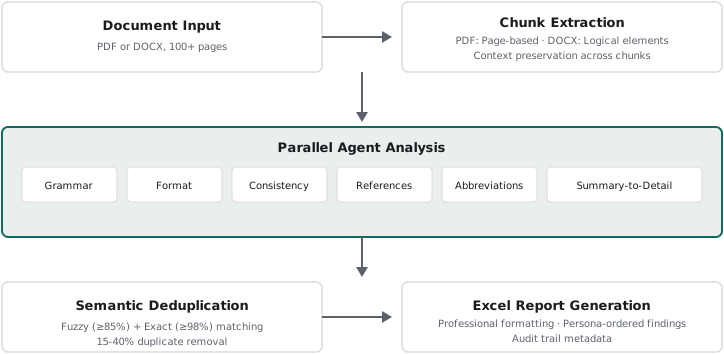
Pharmaceutical companies submit thousands of pages of documentation to the FDA for drug approval. Each document requires comprehensive quality review for:
- Grammar and spelling errors
- Formatting consistency
- Cross-reference accuracy
- Abbreviation definitions
- Summary-to-detail alignment
Manual review is:
- Labor-intensive (regulatory professionals spending hours on repetitive analysis)
- Inconsistent (different reviewers catch different issues)
- Expensive (specialized expertise required, $150-300/hour)
- Time-pressured (FDA submission deadlines are fixed)
The Cost
- Each document requires 4-8 hours of manual review
- A single submission may include dozens of documents
- Inconsistent review quality across different reviewers
The Solution
Multi-Agent Architecture
Rather than a single monolithic LLM prompt, the system uses 6 specialized agents, each focused on a specific analysis domain:
Why Multi-Agent?
| Approach | Pros | Cons |
|---|---|---|
| Single prompt | Simple | Token limits, inconsistent coverage, hard to maintain |
| Multi-agent | Specialized expertise, maintainable, parallel processing | Coordination complexity, deduplication needed |
The multi-agent approach delivers:
- Specialization: Each agent optimized for its domain
- Parallelization: 50+ concurrent API calls
- Maintainability: Update one agent without affecting others
- Extensibility: Add new analysis types as agents
Agent Specifications
| Agent | Purpose | Developed By |
|---|---|---|
| Grammar | Spelling, grammar, punctuation errors | Me |
| Format | Formatting consistency, printing issues | Me |
| Consistency | Document-wide pattern detection | Me |
| References | Citation and cross-reference validation | Me |
| Abbreviations | Abbreviation definition tracking | Me |
| Summary-to-Detail | Gap identification between sections | Team member |
Implementation
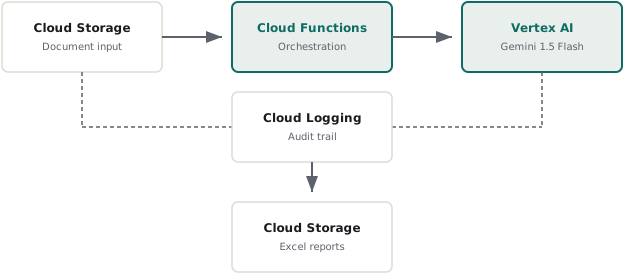
Cloud Architecture
Technology Stack
| Component | Technology | Rationale |
|---|---|---|
| Compute | Cloud Functions (2nd gen) | Event-driven, auto-scaling, serverless |
| AI Model | Vertex AI Gemini 1.5 Flash | Fast, cost-effective, large context window |
| Orchestration | LangChain | Agent abstraction, prompt management |
| Document Processing | PyMuPDF, python-docx | Robust PDF/DOCX extraction |
| Infrastructure | Terraform | Reproducible deployments |
Deduplication Algorithm
Multi-agent + multi-shot analysis generates duplicate findings. The deduplication engine uses:
- Similarity Scoring: 50% sentence content + 50% suggestion content
- Thresholds: Exact match ≥98%, Fuzzy match ≥85%
- Cross-batch comparison: Findings from different chunks/shots compared
Results: 15-40% duplicate removal across multi-shot analyses.
GxP Compliance
GxP (Good Practice regulations) governs quality and traceability in pharmaceutical manufacturing. The system addresses these requirements:
| Requirement | Implementation |
|---|---|
| Audit trail | Cloud Logging captures all processing decisions |
| Reproducibility | Configuration-driven, versioned prompts |
| Traceability | Document → Chunk → Finding → Report lineage |
| Access control | GCP IAM with least-privilege roles |
| Data integrity | Immutable GCS storage for inputs/outputs |
My Role
| Responsibility | Activities |
|---|---|
| Solution Architect | Designed multi-agent architecture, deduplication strategy, cloud infrastructure |
| Agent Developer | Built 5 of 6 specialized analysis agents |
| Project Manager | Timeline, deliverables, client communication |
| Client Liaison | Requirements, demos, business case validation |
Team Structure
- Me: Architecture, 5 agents, PM, client liaison
- Team member: Summary-to-Detail agent
- Client stakeholders: Regulatory leadership, QA team, IT
Results
Performance Metrics
| Metric | Value |
|---|---|
| Processing speed | ~18 seconds/page |
| 5-page document | 1m 23s |
| 33-page document | 10m 12s |
| 100+ page document | Linear scaling (~18s/page) |
| Concurrent API calls | 50+ |
| Deduplication rate | 15-40% |
Business Impact
| Metric | Impact |
|---|---|
| Manual review reduction | 60-70% estimated time savings |
| ROI projection | Multi-million USD savings (client-validated) |
| Ongoing investment | 1 FTE continuing development |
| Strategic partnership | Google Cloud co-sponsorship negotiated |
vs. Manual Review
| Manual Review | AI-Assisted Review |
|---|---|
| 4-8 hours per document | 30 minutes processing + 1-2 hours review |
| Reviewer fatigue affects quality | Consistent quality on every document |
| Limited by headcount | Scales automatically |
| Variable coverage | Comprehensive 6-dimension analysis |
Lessons Learned
-
Multi-agent coordination requires deduplication. Different agents analyzing the same content will find overlapping issues. Semantic deduplication is essential.
-
Rate limiting strategy needs ceiling. Simple exponential backoff can grow unbounded. Implement max delay (61s) with reset.
-
Document format affects chunking strategy. PDF and DOCX require different approaches - page-based vs. logical element-based.
-
Externalize configuration. Prompt updates without redeployment dramatically speeds iteration.
-
Persona ordering prevents confusion. When multiple agents report similar findings, consistent ordering helps users process results.
Impact
AI-assisted document review changed the economics of FDA submissions for this client:
- 60-70% reduction in manual review time on validation reports - regulatory professionals focus on judgment calls, not grammar checking
- Consistent coverage across every document - no more variability between reviewers or reviewer fatigue on page 80
- Scalable capacity during submission crunch periods - the system handles volume spikes without headcount
The client validated a multi-million USD savings projection and committed 1 FTE to continue development. Google Cloud co-sponsorship negotiations are underway for expanded deployment.
Want to discuss AI document review?
Building a similar system for document review, compliance, or quality assurance? I’ve shipped this pattern across pharma, biotech, and enterprise contexts. Get in touch.
Related work
AI Brain Fry Is Real - But It's Not the Tools' Fault
Harvard Business Review says AI is frying workers' brains. My data - 1,986 commits and 1,900 AI sessions in 76 days - shows the opposite is possible. The difference isn't the tools. It's whether anyone invested in actually understanding them.
Your AI Strategy Is Collecting Dust
Most AI strategies fail before implementation starts. Not because the ideas are wrong - because the strategy was built for a board deck, not for the people doing the work. Here's how to build one that actually gets executed.
Your agents know exactly what you tell them
Most people's AI instructions are empty or stale. The ones getting consistently better results are transferring judgment, not just preferences - and they have a system for keeping it current.