Enterprise Data Governance Transformation
€400K engagement, 25+ stakeholders, 7 data domains mapped across 13 countries
- Client
- Specialty pharmaceutical company
- Industry
- Pharmaceutical
- Period
- April 2025 - September 2025
- Role
- Technical Lead
The Problem
Company Context
A Swedish pharmaceutical company selling specialized products across 13 European markets. They’d grown through acquisitions, sold through multiple online channels (Amazon, Shopify, direct), and relied on a network of manufacturing and logistics partners.
Growth Through Acquisition Created Data Chaos
| Symptom | Business Impact |
|---|---|
| 25% of core business data outdated | Wrong product information reaching customers |
| 8+ systems with inconsistent data | Staff spending hours manually cross-checking |
| No clear data ownership | Nobody accountable when data is wrong |
| Excel-based processes | No audit trail, key-person dependencies |
| Regulatory gaps | EU compliance deadlines at risk |
Why Now?
- Regulatory deadline: New EU regulations required standardized product data by 2025
- E-commerce growth: Scaling online channels requires reliable product data
- M&A integration: Recent acquisitions need data harmonization
- AI readiness: Clean, governed data is the prerequisite for any meaningful AI initiative
- Operational cost: Manual data reconciliation consuming too many resources
The Solution
Scope
| Dimension | Scale |
|---|---|
| Engagement value | €400,000 |
| Duration | 6+ months (initial phase) |
| Data domains | 7 |
| Stakeholders | 25+ |
| Countries | 13 |
| Systems mapped | 8+ |
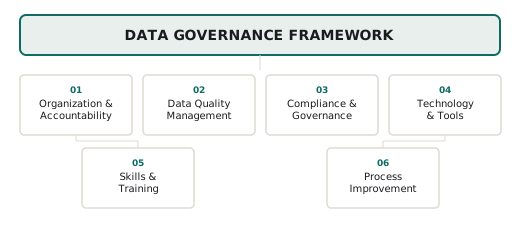
Six Governance Pillars
| Pillar | Business Value |
|---|---|
| Organization & Accountability | Clear ownership - someone is responsible |
| Data Quality Management | Metrics and thresholds - problems caught early |
| Compliance & Governance | Regulatory readiness — meeting EU and international requirements |
| Technology & Tools | System clarity — what data lives where |
| Skills & Training | Team learns to maintain this themselves |
| Process Improvement | Governance that gets better over time |
7 Data Domains Mapped
| Domain | Data Owner | Key Systems | Status |
|---|---|---|---|
| Product Master Data | Operations MD | ERP, PIM, Serialization | Validated |
| Product Innovation | Innovation Lead | ERP, Excel, Project Management | Sent for review |
| Product Business Logic | Business Control | ERP, Excel, BI | Validated |
| Regulatory & Compliance | Regulatory Team | Veeva, ERP | Validated |
| Customer Master Data | TBD | ERP, 3PL systems | WIP |
| Customer Pricing | Global RGM | ERP, Excel | WIP |
| Supply Chain & Logistics | Ops | ERP, 3PL systems | Established |
Implementation
My Role
| Responsibility | Activities |
|---|---|
| Technical leadership | Framework design, methodology, deliverables quality |
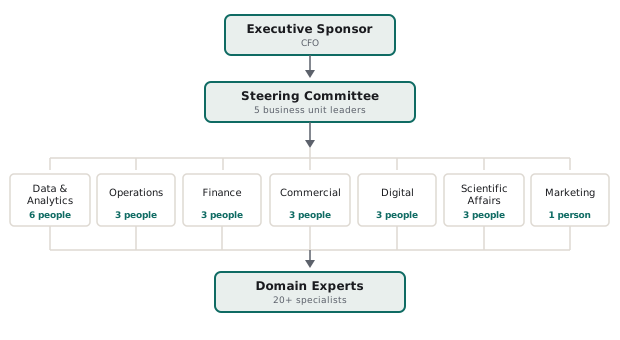
| Stakeholder coordination | 25+ stakeholders across 7 departments |
| Workshop facilitation | Domain definition, validation, reference groups |
| System analysis | Data flow mapping, integration architecture |
| Deliverable production | Documentation, RACI matrices, roadmaps |
Team Structure
- Project Lead: Senior Manager
- Technical Lead: Me
- Consultant: Supporting analyst
Stakeholder Ecosystem
This wasn’t a technology project with stakeholders - it was a stakeholder project with technology:
Workshop Cadence
| Workshop Type | Frequency | Purpose |
|---|---|---|
| Domain definition | Weekly | Define data families, ownership |
| System analysis | Weekly | Map data flows, integrations |
| Reference group | Bi-weekly | Cross-functional validation |
| Steering committee | Monthly | Progress, decisions, escalations |
Key Challenges Navigated
Multi-Country Complexity
Problem: Different markets had different product codes, naming conventions, and processes.
Approach: Focus on core product master data first, acknowledge regional variations, establish global standards with local flexibility.
System Fragmentation
Problem: 8+ systems with no single source of truth.
Approach: Map each system’s responsibilities, identify which system owns each piece of data, and design processes to keep them in sync.
Resource Competition
Problem: Stakeholders had day jobs — governance was additional work.
Approach: Executive sponsorship, structured workshops (time-boxed), documentation that didn’t require re-work.
Regulatory Compliance
Pharmaceutical companies face overlapping regulations that all demand clean, traceable data:
| Regulation | What It Requires | What We Did |
|---|---|---|
| EU product regulations (IDMP/EUDAMED) | Standardized product identification data by 2025 | Identified gaps, built a remediation roadmap |
| Manufacturing quality standards (GxP) | Full audit trail and change control | Mapped requirements to data controls across systems |
| GDPR | Documentation of how customer data is processed and retained | Built privacy considerations into the customer data domain |
Results
Deliverables
| Deliverable | Business Use |
|---|---|
| 7 domain definitions | Clarity on data scope and boundaries |
| 13 data family catalogs | Detailed documentation of every data element |
| System landscape map | Visual overview of all systems and how they connect |
| Data flow diagrams | Understanding how data moves between systems |
| RACI matrices | Clear ownership — who’s responsible, who approves, who needs to know |
| Implementation roadmap | Prioritized next steps |
Business Impact
| Outcome | Impact |
|---|---|
| Ownership clarity | Every data domain has an assigned owner |
| Compliance roadmap | Clear path to meeting EU regulatory deadlines |
| System documentation | First complete picture of how data flows across 8+ systems |
| Issue identification | Critical gaps surfaced and prioritized |
Lessons Learned
-
Governance is people, not just process. 25+ stakeholder coordination was the primary challenge, not technical complexity.
-
Data ownership requires executive backing. Without CFO sponsorship, domain owners couldn’t prioritize governance work.
-
M&A creates persistent data debt. Each acquisition brought incompatible data models requiring ongoing reconciliation.
-
Healthcare adds regulatory complexity. Pharmaceutical regulations (GxP, IDMP, GDPR) layer on top of standard governance — every data decision has compliance implications.
-
Excel is a symptom. Manual Excel processes indicate governance gaps - the fix is process, not tool replacement.
Want to discuss data governance?
If you’re facing similar challenges - data spread across too many systems, regulatory deadlines looming, nobody sure who owns what - I’d be happy to share what worked here. Get in touch.
Related work
AI Translation Pipeline for Pharma
AI translation integrated with Veeva Vault - 2+ week turnaround reduced to hours
Multi-Agent FDA Document Review
6-agent AI system for FDA document review - 60-70% time savings, multi-million USD ROI
When to Halt a Migration
400,000+ documents profiled, 92% scope reduction, migration halted - sometimes stopping is the right answer